

Next week, I’m traveling to Limpopo to learn all about BALENI SALT. I found out about this special salt when researching for my book, The Condiment Book, and had the privilege of finally tasting the rarity last December when I hosted a salt event with Studio H in Cape Town!


In preparation for the salty upcoming trip to Limpopo, I wanted to share with you the salt excerpt of TCB.
Stay tuned for next week’s salty piece!
The Condiment Book - SALT
Salt is a controversial condiment. I like to ask people what their top three condiments are, and I ask myself, frequently, too. Though my second and third choices change daily (Dijon mustard will always be #1), if I mention salt, arguments tend to begin. As with butter, there is salt the ingredient, then there is salt the condiment. A finishing salt is a condiment, the grand finale of a dish, the last word. It can be crunchy, flaky, colourful and even have an added flavour.

When you sprinkle sea salt flakes over basic buttered pasta, you’re levelling up the dish and adding a condiment.
Smoked salt scattered over a lovely seared piece of fish? Condiment.
A pinch of cinnamon-vanilla salt to finish off a vanilla sponge cake? Condiment.
A dusting of tajin on a fruit salad? Condiment.
Please don’t salt your food before tasting it. Don’t get me wrong, I LOVE salt. I am known to keep both soy sauce packets and sea salt flakes in my bag in case of emergencies. However, salt must be used wisely, not just for the sake of it. Take a first bite, see what’s missing: is it actually salt?
Is it texture? Is it acidity? This will depend on your flavour preferences.
I usually miss acidity in a dish, so I reach for a dollop of mustard or a squeeze of lemon juice. However, if I do find salt is that missing puzzle piece, I’ll reach into my bag for my emergency flaky rations.
But WHAT Salt?
Salt comes in many shapes and sizes. The odds are, if you visit a new country, you’ll find a different salt on the table to the type you have at home. Don’t dismiss this, look into it! I have learned fascinating cultural information based on salt itself: its use, pungency, purpose, makers and production process.
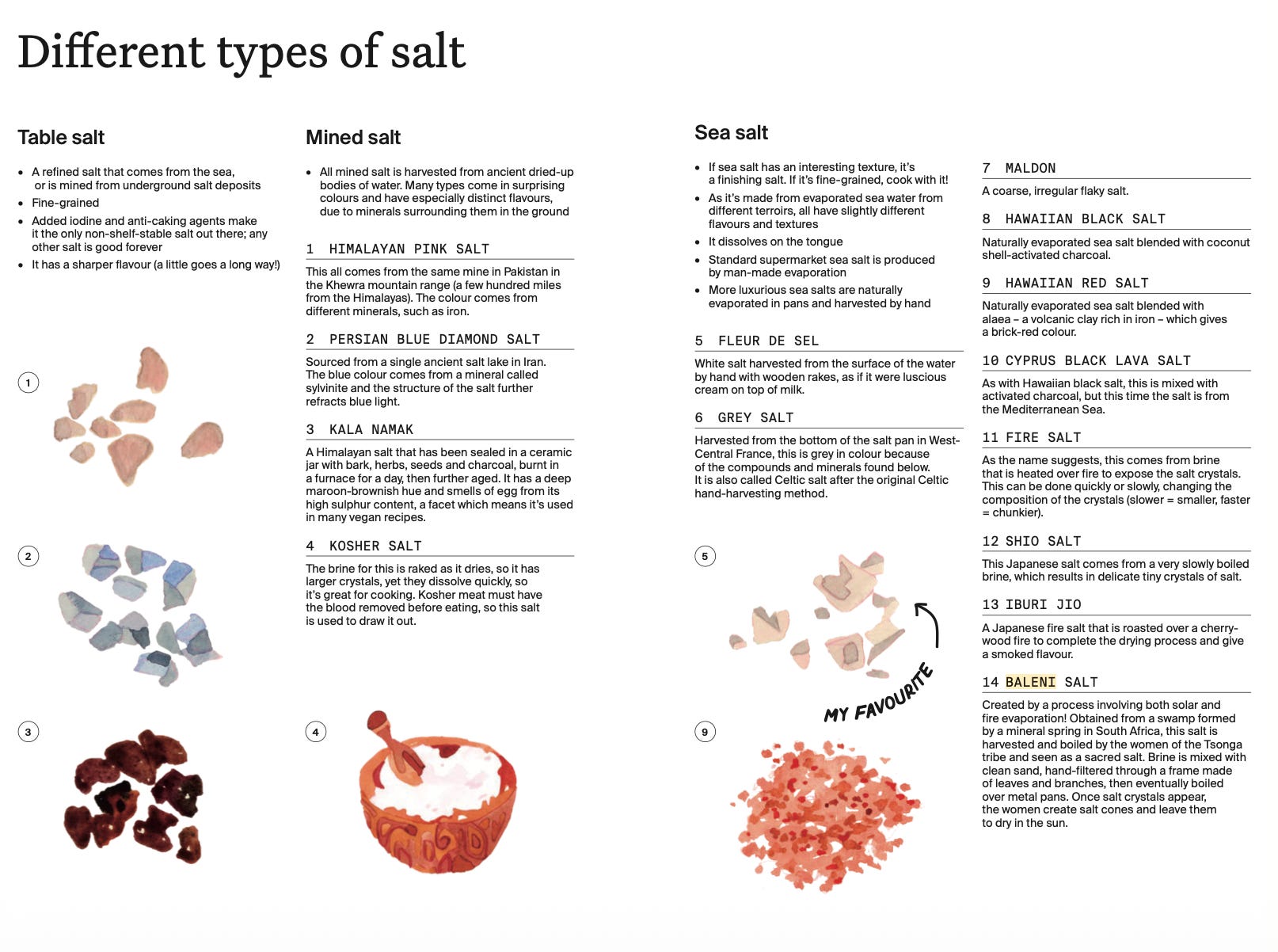
Regardless of its regional name, shape, colour and taste, all salt is made from the same mineral: NaCl, or sodium chloride. It’s the most glorious little compound, which not only enhances flavour and promotes aroma, but also acts as a preservative by curing or fermenting.
All salt originates from a body of water. As time progresses and millions of years pass, some bodies of water (unsurprisingly) dry up, their only remains being salt. In the present day, salt can be divided into two sources: water (ocean, sea, lake, river) and rock salt mines.
Learn more about my trip to Anglesey and harvesting the special Halen Mon here!
Like that of wine, the terroir of a salt will determine its flavour. This simply means that, depending on its environment (think: geography, geology, climate) as well as its method of harvest, all salts will taste slightly distinct from each other. Added minerals and compounds will affect its taste, colour and more. A salt’s texture also changes its flavour; remember how even chewing in different ways can affect the way you perceive taste? A coarse salt will leave a different impression on your tongue - and crunch in between your teeth - than a finer salt that will dissolve subtly in your mouth. Each has an individually beautiful structure that should determine its usage, whether you cook with it or use it as a finishing salt.
My Pantry Essentials linked here!

 Tiktok failed to load.
Enable 3rd party cookies or use another browser
Seasoning is everything. Salt can and should be used in all forms of cooking, but judiciously. It is an angelic mechanism to draw out and amplify flavour and to counterbalance blander foods. Bland isn’t bad, it’s simply neutral and needs a little extra help from our salty friends: think of scrumptious toasty bread, steaming fluffy white rice, or pasta dancing in a pan at a rolling boil.
Worried about oversalting? Undersalting? Salinity depends on the exact salt you choose as well as the amount you’re using, so just add it little by little until you’re perfectly content.

History of Salt
The range of salt’s story is vast and has been the subject of many books. Ancient Egyptians were the first to recognise, in around 2,000 BCE, that sodium drew moisture not only out of food but also out of humans.
Egyptian mummies were commonly packed in salt to ensure their preservation and then shipped down the Nile. These corpses were literally taxed as salted meat!
Ancient Romans also believed salt had curing properties, in many senses: it could cure meat as well as ailments.
While some of us may know that the word salary stems from the Latin word for salt, sal, did you know that the Latin term for wellbeing was salus? Salt was a common medicine for all afflictions, from respiratory to skin to digestive. Due to its all-important nature and numerous uses, sal is the root of many words. Even the term soldier comes from sal-dare, or ‘to give salt’, as these men were paid in salt.
Though it has been highly venerated and used in numerous ways throughout millennia, let’s just focus on salt the condiment, rather than salt the ingredient.
That’s all for today! Can’t wait to share more about my trip to Baleni with you.
Île de Ré Limpopo collab!!!
Can’t wait for Limpopo content!